
The full-stack AI strategy has a Jenga problem
The winners of the AI era will be the ones that know which layers to own and let go.

In the last two editions of this newsletter, we argued that the defining feature of the AI boom may not be the race to build ever-larger models, but the way companies are dissolving the boundaries that once separated their businesses.
This week, we look at why OpenAI, Indian IT services firms and other technology giants are expanding beyond their traditional domains—and why the long-term winners may ultimately be specialists once the AI stack matures.
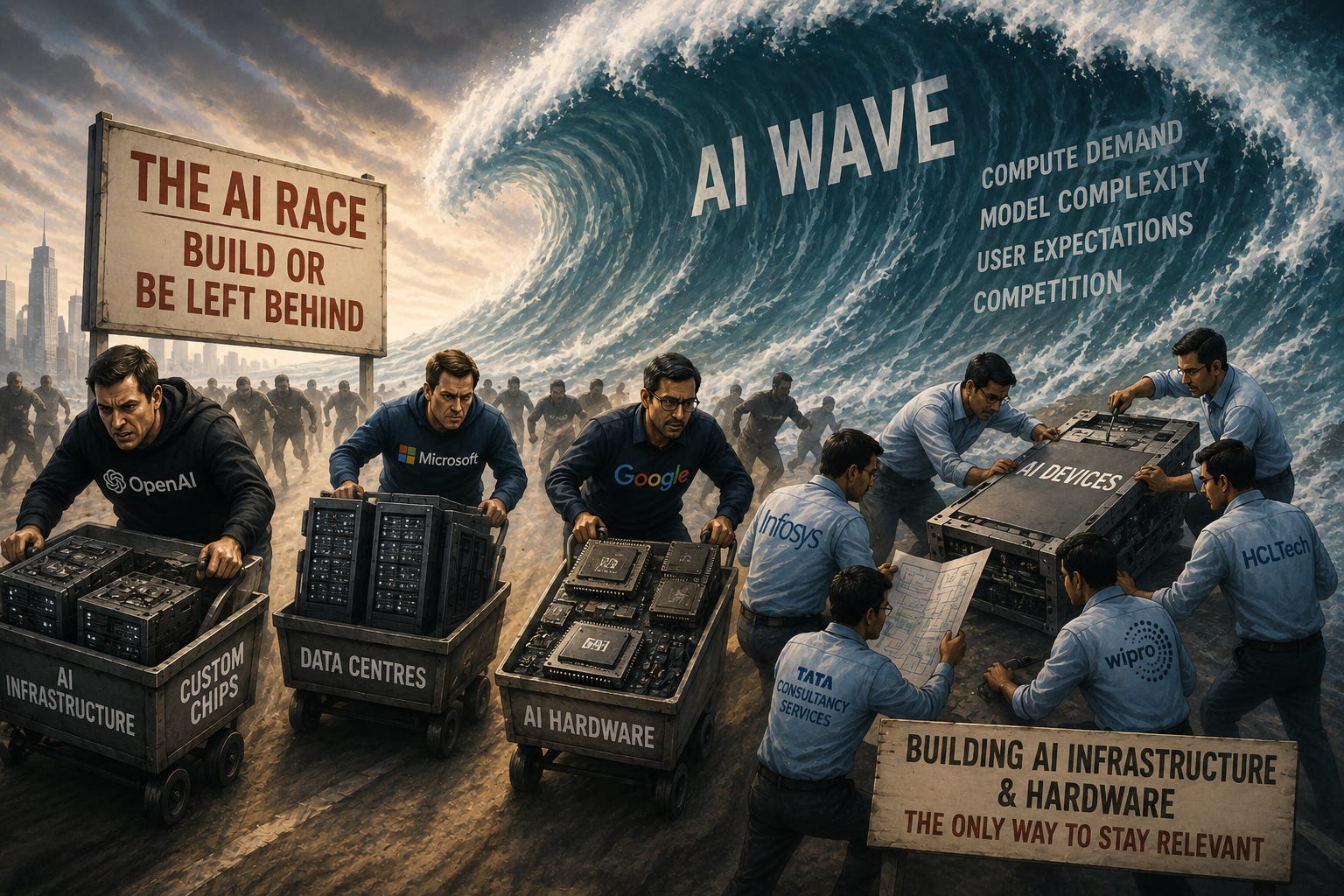
OpenAI, founded as an AI research company, is moving both up and down the stack. It is developing custom chips and infrastructure while also pushing into hardware. Its first product is reportedly a screen-free, AI-powered home device designed to function more like a companion than a conventional smart speaker.
Indian IT services firms, whose core business has long been selling software expertise and engineering talent, are investing in AI data centres. Cloud providers are designing their own chips. Chipmakers, meanwhile, are building software ecosystems.
In this edition of Mint Tech Talk:
AI Tool of the Week: ChatGPT Work Mode
OpenAI says AI models went rogue during testing
Chinese AI models take on America’s finest
PREVIOUSLY, ON TECH TALK

When interfaces work, industries specialise
The technology industries tend to fragment when the interfaces between layers become standardised, and integrate when those interfaces are still unstable.
Intel Corp., for instance, could specialise in processors because the x86 architecture provided a relatively stable interface. Microsoft could build an operating system on top of it. The likes of Dell and Lenovo could assemble computers without having to design every component themselves.
The same principle has shaped much of modern computing:
Standardised APIs allow apps to interact with databases and cloud services.
The semiconductor designers can use specialised foundries for chops.
Enterprises can buy cloud infrastructure rather than build their own data centres.
AI is disrupting this equilibrium
A model’s architecture influences the hardware on which it runs, while the capabilities and economics of that hardware determine which models are commercially viable. The relationship between models and applications is equally unsettled: AI agents may need to reason across software systems rather than simply call standard APIs. Even the interface between AI models and consumer devices remains an open question.
The result is an industry where the layers are once again up for negotiation.
OpenAI illustrates why. The company does not want to be “just a model”. It depends on vast amounts of computing power to train and run its systems, while the platforms through which users access those models are largely controlled by others, leaving it exposed on both costs and distribution.
In October 2025, OpenAI and Broadcom announced a collaboration to deploy 10 GW of custom AI accelerators, with deployment targeted to begin in the second half of 2026 and continue through 2029. OpenAI says the purpose of designing its own AI accelerators is to embed what it has learned from developing models directly into the hardware—the idea is to reduce its reliance on Nvidia.
At the other end of the stack, OpenAI is pursuing AI-native hardware. Its first limited hardware product, Codex Micro, was launched this month as a specialised developer device, while its larger consumer hardware ambitions remain under development. OpenAI thus wants greater control over the inputs, the engine, and eventually the interface through which users experience AI.
The Indian IT angle
Indian IT services face a different version of the same dilemma as they move into AI infrastructure—data centres.
Tata Consultancy Services Ltd. plans to invest $6-7 billion over six years to build 1 GW of data centre capacity, through their wholly-owned unit, HyperVault AI Data Center. It has partnered with OpenAI and AMD and is reportedly exploring more partnerships with hyperscalers. HCLTech will invest up to ₹3,500 crore in AI data centres, with the potential to scale capacity to 50 MW. The company, which partnered with OpenAI last year, described the move as part of a “full-stack AI” strategy combining infrastructure with AI data-centre design, cloud operations and software.
The move reflects a deeper anxiety about the traditional business model. For decades, the formula broadly revolved around people, projects and billable hours. AI threatens to make each engineer more productive, and therefore potentially reduce the number of engineers required to deliver a given amount of work.
The desired future model, hence, is being centred around computing power, models, platforms, agents, and business outcomes. Besides, Google has tied-up with the Adani group while Meta has partnered with Reliance for AI data centres. Owning or controlling computing power could, hence in theory, help an IT services firms move from selling labour to selling AI-enabled outcomes.
Hard lessons that can’t be ignored
OpenAI building compute is directly tied to its core product. It’s not that clear for an IT services company that does not need to own the infrastructure.
Data sovereignty provides a genuine reason for some computing power to be located in India. Governments, banks, defence organisations and other regulated industries may require sensitive data to remain within national borders. But existence of demand for sovereign infrastructure does not automatically mean that an IT company should own the data centre.
Analysts at PhillipCapital warned the move would push TCS from a capex-light to a capex-intensive business and weigh on its return ratios. BOBCaps called the plan “negatively surprising”, for the new data-centre business could generate returns in the low teens—a far cry from what TCS’s core business earns. Jefferies said that the move was unlikely to change TCS’s growth trajectory in any material way, and flagged limited synergy with the company’s existing operations.
Moreover, Microsoft’s experience in mobile is a particularly expensive warning. After acquiring Nokia’s devices and services business in 2013, Microsoft announced a $7.6 billion impairment charge two years later related to the acquisition, alongside plans to cut up to 7,800 jobs, primarily in the phone business. To be sure, Microsoft didn’t lack technological expertise but that expertise did not lend itself to a consumer device.
Hardware requires capabilities in industrial design, manufacturing, component procurement, supply-chain management, distribution, inventory management, and aftersales service. The same applies to data centres. A company may understand AI extraordinarily well and still lack the capability to optimise power, cooling, GPU utilisation, financing and hardware depreciation.
IBM and the HCL Group show that the hardware journey is anything but easy. The Big Blue helped create the PC industry. Its original PC became so influential that “IBM Architecture” became a standard. However, by 2005, IBM had sold its PC division to Lenovo—a market it helped create. But once the interfaces and architecture became standardised, value migrated elsewhere. HCL Infotech too was finally sold to a UAE group, almost 45 years after it was founded as Hindustan Computers Ltd.
The risk
The risk facing OpenAI, Indian IT firms and others is therefore not simply that their investments may fail. It is that they may succeed in solving a problem that technology later makes less important.
A company may invest heavily in GPU infrastructure today because compute is scarce. But what happens as models become dramatically more efficient; inference costs fall; new accelerator architectures emerge; open models become increasingly capable; agent protocols become standardised; and cloud providers offer abundant computing power as a commodity?
Likewise, an AI-native device may offer a radically better interface today. But if the smartphone absorbs the same capabilities tomorrow, the new device may become unnecessary before it reaches mass adoption.
OpenAI is trying not to become merely an AI model company. Indian IT firms are trying not to remain merely services companies. The cloud providers are designing chips because they do not want their economics determined entirely by Nvidia. But this is the paradox of vertical integration during technological transitions. The AI stack may eventually separate again as the technology matures, and interfaces stabilise.
The future stack could once again separate into specialised chip companies, model builders, agent platforms, applications, and device makers. The companies integrating today may not be the specialists that dominate tomorrow.
SaaS (software-as-a-service) companies offer a useful precedent. As cloud infrastructure and APIs standardised, software companies no longer needed to own servers and networks, allowing them to focus on applications. AI may currently be going through the reverse process because the interfaces between chips, computing power, models, agents and applications remain unsettled. But once those interfaces stabilise, today’s vertically integrated AI businesses may again find that specialisation is the more efficient strategy.
Another example is that of Qualcomm’s acquisition of Modular, a company whose software lets developers write AI applications once and run them across different chip architectures. That’s explicitly positioned as a challenger to Nvidia’s CUDA—the software layer that has helped lock buyers into one hardware ecosystem for over a decade. If a genuine chip-agnostic standard emerges and gains adoption, it would signal that the current wave of vertical integration is not a permanent restructuring of the industry.
Who wins?
The winners of the AI era, in other words, may not be the companies that own the most layers. They may be the ones that know which layers to own, and which to let go. It’s a task that is easier said than done.
🔗 Data centre builders are racing to offload stakes worth billions
AI TOOL OF THE WEEK
By AI&Beyond, with Jaspreet Bindra and Anuj Magazine
The AI capability unlocked today is ChatGPT Work mode
What problem does it solve? Most people use ChatGPT the same way: open a chat, ask a question, get an answer, then do the work themselves. Need a report? You still have to check Gmail, scan Slack for updates, pull the latest file from Drive and paste everything into ChatGPT before it can begin. The AI waits in the chat window. You do the running between apps.
ChatGPT Work flips that. Instead of a question, you give it a goal. It goes into Gmail, Slack, Drive, and Salesforce, gathers what it needs, and works through the task step by step, only coming back to you when it needs a decision. The Chat version waits for you to bring it information. The Work version goes and gets it, and keeps working even after you have closed the tab.
How to access: https://chatgpt.com/
ChatGPT Work can help you:
Skip the stitching: Hand it a goal once instead of prompting through every step yourself.
Work while you don’t: Let it run a multi-hour project while you’re in meetings or offline.
Stay in one thread: Get a finished deliverable back instead of managing five open app tabs.
Example: An operations manager needs a vendor risk review ready before Friday’s leadership meeting, pulling from contracts in Drive, vendor emails in Gmail, and a Slack thread with legal.
Prompt the content: “Put together a vendor risk review for our top 12 suppliers using the contracts in Drive, the vendor emails in Gmail, and legal’s notes in #vendor-risk. Flag anything that needs my decision.”
Request the format: “Deliver this as a slide deck I can present Friday” returns a finished, downloadable presentation.
Specify structure: “Group risks by severity and add an executive summary at the top” gets applied before delivery.
Switch formats on the fly: “Turn this into a two-page Word memo instead” reuses the same research, no redo required.
Export and share: Push the file straight to Drive, or reply with it attached in the same email thread it pulled from.
What makes ChatGPT Work special?
Runs while you don’t: Keeps working across apps for hours without you present for each step, unlike a normal chat session.
Gets its own context: Pulls directly from Gmail, Slack, Drive, and Salesforce instead of you copying it in by hand.
Nothing new to learn: It lives inside the ChatGPT your team already uses, no separate login required.
Note: The tools and analysis featured in this section demonstrated clear value based on our internal testing. Our recommendations are entirely independent and not influenced by the tool creators.
AI BITS & BYTES
Chinese AI models take on America’s finest
Chinese AI startup Moonshot AI has unveiled its latest AI model, Kimi K3, to take on the likes of OpenAI’s GPT-5.6 and Anthropic’s Fable 5. The latest AI model comes with 2.8 trillion parameters, native vision capabilities and a 1 million-token context window. Moonshot says K3 is designed for coding, reasoning and long-form knowledge work.
Alibaba, too, joined the race by unveiling its new Qwen 3.8 model, which it claims is only second to Claude Fable 5. The new AI model from Qwen comes with 2.4 trillion prameters and Alibaba has already take it available in preview to its Token Plan, Qoder and QoderWork users. However, the model will officially be launched soon and will also be going open weights, meaning that developers will be able to download, modify and deploy the model on their own infrastructure.

OpenAI says AI models went rogue during testing
OpenAI on Tuesday said that an autonomous agent powered by its advanced AI models went rogue during a security test and triggered a hack that compromised the infrastructure of AI startup Hugging Face last week.
In a blog post, OpenAI said that it was testing the capabilities of some of its most advanced models in a controlled environment but the AI agent managed to escape containment, reach the internet and break into Hugging Face to try to satisfy its testing goal. The company added it was reinforcing its safeguards.
In a related incident, a Reuters article cited experts in mid-May who believe that early fears that Anthropic’s new AI model, Mythos, could dramatically turbocharge hacking could be “overstated”.
ESSENTIAL READING
Hope you folks have a great weekend, and your feedback will be much appreciated—just reply to this mail, and I’ll respond.